Within the demanding arena of contemporary serious sliding, podium finishes is not merely purely a result of brute engine power or behind-the-wheel aggression. Instead, it has become a multifaceted engineering challenge which demands a painstaking fusion of picking a time-tested vehicle platform, arming it with the highest-quality drift-spec components, and, most essentially, understanding its dynamic characteristics on the track through cutting-edge suspension tuning applications. This comprehensive guide will serve as your blueprint starting from the very first concept of a project car through to the final telemetry-optimized refinements that transform a capable vehicle into a consistent winner. We will thoroughly explore the methodical process of car suspension tuning, illustrating how a advanced suspension tuning tool like a dedicated telemetry system removes approximation and offers unparalleled clarity into your vehicle's actual dynamics.
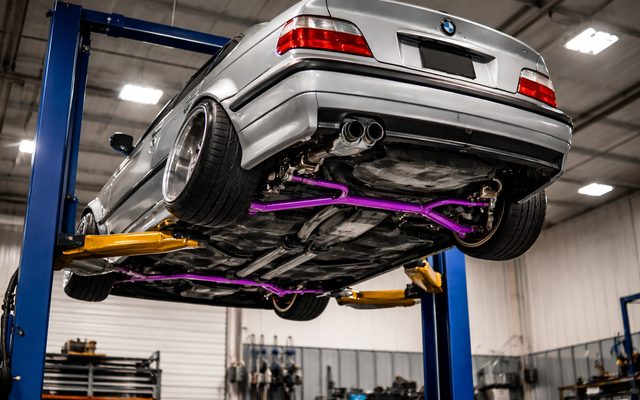
The cornerstone of any great drift machine is, undoubtedly, the platform itself. Several cars have attained legendary reputation within the worldwide sliding culture due to their built-in weight distribution, robust construction, and the enormous range of performance components available. Choosing the optimal car is the initial and most significant choice a enthusiast will make. As an example, the BMW's E36 3 Series is universally acknowledged as one of the best balanced cars for drifting of the modern era. Its almost ideal balanced front-to-rear weight, combined with a rear-wheel-drive configuration and bulletproof inline-six motors, establishes a platform that is both easy to handle for newcomers and extremely capable in the possession of a pro driver. The next step of this concept, the E46 model BMW, improves on these attributes with a increasingly sophisticated structure, broader track for enhanced stability, and even more lock directly from the factory. Another formidable contender in the top-level scene is the Corvette C6.
This muscle-derived performance car introduces a distinctive set of advantages to the sideways sport, such as a light alloy structure, a rear-mounted transaxle that aids in an ideal balance, and the colossal thrust of a large-displacement GM LS engine. This fusion makes it an absolute weapon on track, capable of initiating and maintaining long drifts with seemingly effortless application of power. For drivers seeking remarkable performance per dollar, the 350Z model Nissan stands out as a excellent candidate. It comes from the factory with a stiff chassis, a effective original limited-slip differential, and the smooth VQ series motor that offers ample power and torque for learning and progressing in the discipline. Its successor, the Nissan Z34, brings further improvements in structural rigidity, handling precision, and outright engine power, cementing its place as a favorite choice among serious pilots. Additional legendary cars that warrant consideration include the nimble Wankel-engined Mazda FC, the most popular Nissan S13 240SX, the V8-powered SN95 generation Mustang, the modern BMW E90, and the compact yet surprisingly engaging and teachable MX-5 Miata. Each of these platforms provides a unique array of traits, complexities, and potentials, but they all have in common the fundamental elements required to serve as a competitive drift machine.
However, picking the right platform is only the first step. To unlock the full performance of every of these vehicles, major upgrades to the steering and chassis control systems are completely non-negotiable. This is where the world of specialist aftermarket parts comes into vital focus. The one most impactful improvement for a serious competition vehicle is the installation of a maximum-angle drift angle kit. These advanced assemblies, such as those engineered by performance brands like specialist manufacturers, are created to dramatically expand the chassis's available turning lock. A factory road car is highly limited in how far its tires can pivot, a design limitation for public road use. In oversteer driving, but, extreme countersteering is frequently necessary to manage and hold a slide. An steering kit replaces the stock steering knuckles, linkages, and sometimes A-arms with parts that permit the front tires to attain degrees of turn beyond 70 or even 80 degs, compared to a normal stock limit of around 40 to 50 degrees.
This tremendously greater lock offers the driver with exponentially more authority during a slide, enabling it to be much simpler to initiate a oversteer moment, maintain it through a long turn, and transition smoothly from one side to the opposite. The improvement in drivability is truly profound. Coupled with a properly selected modification is the equally vital enhancement to the vehicle's damping system. Generic or even expensive street adjustable suspension are generally not engineered for the particular and harsh demands of drifting. A drift-spec system of suspension units is of utmost importance. These engineered dampers incorporate custom piston tuning and spring strength that are tuned for the violent mass transition that is inherent of drifting. When a driver begins a drift, the car's mass is transferred forcefully to the outer of the bend. Proper competition coilovers control this shift in a predictable manner, permitting the chassis to find its balance promptly and giving the operator clear feedback through the controls and cockpit. They also allow for precise setting of ride height, rebound and compression rate, and weight balance, which are all fundamental elements of fine-tuning the vehicle's dynamics to a specific circuit or driving style. Together, a high-quality drift angle kit and a expertly chosen pair of competition adjustable dampers constitute the core physical foundation upon which all later refinement is based.
Once the fundamental hardware is fitted, the subsequent essential phase in the build is the precise tuning of the chassis's wheel angles. This is the domain of chassis dynamics adjustment, a methodology that can appear intimidating to the beginner but is, in reality, the defining factor to converting a assembly of fast components into a cohesive and consistent whole. The most critical aspect of suspension geometry for oversteer is undoubtedly negative camber. Wheel camber is the inclination of the tire compared to the perfectly straight axis when looked at from the forward of the car. If the upper part of the wheel is angled towards the car, this is known as negative camber. For sliding, inward-leaning wheels on the front tires is generally used and is considered critical. The logic is deeply linked to vehicle dynamics.
When a car is cornering at extreme sideways angles, the chassis rolls toward the outside of the bend. This lean makes the outer front tire to diminish its best grip area with the asphalt. By applying negative camber, the tire is pre-leaned to account for this roll. As the car rolls into the bend, the outside front tire gains a better contact patch against the track, maximizing its traction at the exact point when it is most required for control. Commonly, front camber settings for a serious drift car vary from approximately -3 degrees to as much as -5 degrees or even more, contingent on the parameters of the vehicle geometry, tire type, and operator preference. The rear wheels also employ negative camber, but the values are vehicle dynamics tool generally more modest and subtler than the front. Too much camber at the rear can cause the vehicle to excessively tail-happy and challenging to control on throttle use, as it diminishes the effective tire footprint of the driving wheels during linear acceleration. Hence, rear angles are often in the range of -1 degree to -3 degrees, finding a delicate compromise between giving sufficient side traction to aid in initiating and maintaining the slide while also maintaining effective grip for acceleration the bend. camber angle is only one part of the broader alignment picture, which furthermore encompasses toe, caster angle, and steer correction adjustment.
Toe setting describes the angle of the tires as seen from the top. Toe-in means the leading edges of the wheels are nearer together than the trailing edges, while toe-out means the opposite. For drifting, a small amount of front toe-out is often used to sharpen the turn-in handling reaction, making the vehicle feel more nimble and willing to start a oversteer moment. Rear axle toe angle is generally set to neutral or a incredibly minute amount of positive toe to foster straight-line stability under throttle. Caster is the frontwards or rearward angle of the suspension pivot when viewed from the side-on of the vehicle. Increased caster angle increases feedback and stability stability, and it also boosts camber effect during cornering, which is highly advantageous. Setting these values is a complex interplay where a adjustment to one value can and will influence the remaining parameters. The old-school method for setting a chassis's alignment for drifting has long been a time-consuming affair of guesswork and adjustment. A tuner or crew would apply a modification based on a hunch, test the vehicle on track, use the pilot's individual perception and feedback, and then introduce an additional tweak. This process would iterate over and over until the vehicle felt "right" or the available track time ran out. This system is not just exceptionally slow in terms of man-hours and drift angle kits tires, fuel, and parts, but it is additionally inherently imprecise.
Human feel is a famously subjective measurement tool, influenced by numerous factors such as fatigue, evolving track conditions, ambient heat, and merely the focus of the driver on that specific day. What feels "oversteery" on one pass might feel "tight" on the following pass, leading to conflicting information and counterproductive adjustments. This long-standing limitation in vehicle dynamics optimization is specifically where state-of-the-art technology has intervened to transform the process.
The rise and application of advanced suspension tuning applications has introduced a radically different era for engineering and refining professional drift cars. These platforms, represented by cutting-edge systems like GripDial, function by actively capturing the real-time dynamic behavior of the chassis as it is operated on the track. As opposed to depending on personal feel, these tools collect objective metrics on essential parameters such as shock absorber movement, corner velocities, acceleration forces, wheel angle, and driver input application. This collected telemetry is then processed by powerful algorithms that can plot and decode the metrics in a clear manner. For the first time ever, tuners and crews can visualize specifically what the car is doing at every moment of a drift. This function revolutionizes the complete chassis setup process. Imagine the particular goal of optimizing the front axle camber for a specific car. Instead of introducing a change from -3 degrees to -3.5 degrees and then driving several runs to try and "perceive" a difference, a telemetry system can give instant and irrefutable data. The application can indicate visually how the wheel's loading is performing during the critical moments of a angle: initiation, sustain, and changing direction. It car alignment tuning can demonstrate if the present camber setting is permitting the outside front tire to keep maximum loading or if the tire is over-stressed on its external edge.
The tool can after analysis make data-driven suggestions for adjustment. Perhaps the telemetry shows that the tire is still overworking its edge at -3.5 degrees of camber, implying that a move towards angle, say -4 degrees, might be advantageous. Alternatively, the data might show that the tread is failing to coming up to temperature or that the inner edge is wearing unevenly, which could suggest that there is overly aggressive inward lean and a modest reduction back to -3.2 degrees would be more optimal. This degree of accuracy and practical insight was literally unimaginable in the time of solely mechanical setup.
The effect of utilizing a advanced vehicle dynamics tool reaches far beyond only optimizing camber angles. It functions as an essential coilover setup tips that is tailored to your specific chassis. When setting the rebound and compression clickers on your coilovers, instead of depending on general guidelines or copying another driver's settings, you can employ the telemetry to see how the car is performing in response to your adjustments. The tool can graph the suspension travel path over a run, highlighting if the dampers are managing the body movement optimally or if they are causing the car to bounce too much after a direction change. It can aid in pinpointing issues like bottoming out or losing droop, allowing you to introduce data-backed adjustments to preload settings, damping rates, or ground clearance. This methodology applies just as well to the complex task of suspension geometry optimization. In addition to camber angle, the software can offer analysis into how adjustments to toe settings and caster angle are affecting the chassis's stability during specific parts of a drift. For instance, it can allow you to ascertain the ideal amount of front axle negative toe for your specific steering rack geometry and competition approach by measuring the response time of initial reaction and the predictability of the vehicle at lock steering angle. This turns the system an incredibly effective performance optimization handbook that is constantly calibrated by the actual performance of your own car on the track. It moves the entire endeavor from a mysterious craft into a methodical optimization process.
Moreover, the value of a system like GripDial is not restricted to experienced teams with extensive resources. For the amateur enthusiast, it serves as an powerful equalizer. It effectively offers the tuner with the insight of a expert suspension specialist without requiring the corresponding overhead. It speeds up the tuning process by providing clear solutions to challenges that would traditionally take seasons of trial and error to solve. A driver can understand how their particular car responds to specific inputs, developing a more profound knowledge of vehicle dynamics in the process. It also opens up high-level chassis dynamics techniques, permitting anyone with the desire to perfect their machine to accomplish it in a efficient and effective manner. This is particularly important in a sport like sliding, where tuning know-how has historically been a highly secretive advantage among elite drivers. Now, that power can be in the garage of any motivated driver.
In summary, the journey to constructing and dialing in the ultimate competitive sliding vehicle is a multi-faceted endeavor that smoothly blends proven hardware principles with 21st-century data technology. It starts with the strategic pick of a capable car, then enhanced by the installation of non-negotiable performance parts like high-performance drift angle kits and expertly selected competition suspension units. The process then progresses into the precision stage of alignment optimization, where values like negative camber, toe, and caster are precisely adjusted to suit the chassis's new capabilities and the pilot's individual style. The final step, and what truly distinguishes the contemporary process from the traditional methods, is the adoption of a advanced drift telemetry software. This system removes the uncertainty and trial and error of solely feel-based tuning by providing empirical, actual information on how the vehicle is truly performing. It functions as an unparalleled engineering partner, a actionable alignment optimization handbook, and a all-in-one performance analyzer. In unison, this holistic methodology guarantees that every component of the drift machine—from the selection of the chassis to the final adjustment on the damper—is refined for maximum performance on the circuit. It signifies the full progression of the discipline of drifting, merging physical pilot talent with data-informed chassis dynamics to build the ultimate competitive cars attainable.